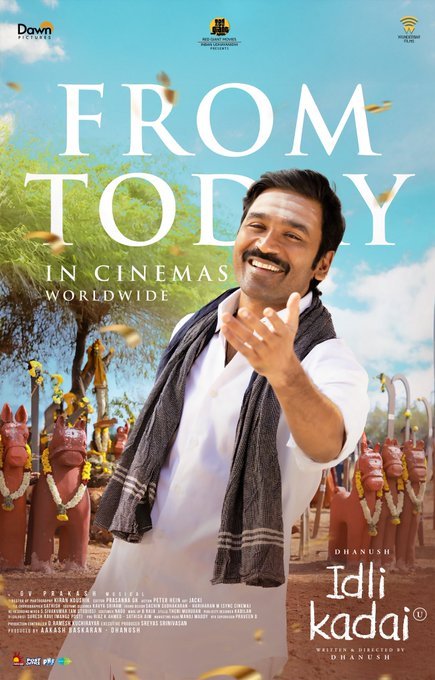
Idli Kadai Movie Review: In Idli Kadai, Dhanush wears many hats—actor, writer, director, and co-producer. It’s his attempt at serving us a nostalgic, emotional slice of rural life, stirring together family bonds, identity, and the tug of dreams versus roots. The film is heartfelt and familiar, but it doesn’t always escape clichés. Yet it leaves you with moments worth remembering.
Synopsis (Without Spoilers):
Murugan (played by Dhanush) grows up in a small village where his father runs a modest idli shop, known and loved by the community. Dreaming of a bigger life, Murugan leaves for the city and ends up working in a hotel business run by the wealthy Vishnu Varadhan (Sathyaraj). He’s engaged to Meera (Shalini Pandey), the daughter of the hotel owner. But fate drags him back to his village: circumstances force him to take charge of his father’s idli shop, reconnect with his roots, and confront Ashwin (Arun Vijay), a privileged and prideful antagonist determined to bring him down. As Murugan grapples with his identity and purpose, the past and present collide.
What Works:
Heartfelt Emotion & Relatability:
One of Idli Kadai’s biggest strengths is its connection to universal emotions: the love for one’s home, the conflict between ambition and duty, and the nostalgia for simpler times. Many viewers have praised the film for being “highly relatable.” The rural setting, village dialogues, and small-town characters feel authentic and grounded.
Strong Performances:
Dhanush carries the film with conviction. He walks the fine line between determination and vulnerability, and he gives us a lead character who’s flawed but sympathetic. Supporting actors like Rajkiran (as Murugan’s father) bring gravitas to their roles. The villainy of Arun Vijay is sharp, though fairly conventional. Nithya Menen offers warmth and emotional support as Murugan’s love interest.
Music & Atmosphere:
GV Prakash Kumar’s score and songs suit the tone well. They rarely feel forced, and in quieter moments, the background score carries emotional weight. The rural landscapes, the village streets, and the idli shop scenes are lovingly shot by cinematographer Kiran Koushik. The visuals evoke a sense of home.
Comfort Food Cinema:
This is not a radical film. It’s a comfort movie—warm, familiar, sometimes predictable. Cinema Express puts it aptly: “warm and fuzzy … familiar but slightly overcooked.” For what it aims to be, it delivers many moments of satisfaction.
What Doesn’t Work So Well
Predictable Plot & Clichés
Much of Idli Kadai treads well-worn ground. The hero returning from the city to revive a family legacy, the villain trying to undermine him, the idealistic parent, the love interest caught between two worlds—these are familiar tropes. The Times of India review also points out that the film is “entirely driven by nostalgia and sentimentality,” sometimes to a fault. The transitions and conflicts follow expected paths, which lessens the sense of surprise.
Uneven Pacing
The first half is better paced, building character and emotional stakes. But in the second half, the narrative occasionally drags, and the hero-villain conflict becomes somewhat formulaic. As noted in forums and early reviews, the film “slides into generic action territory” after a strong start. The emotional resolve sometimes feels rushed or overly neat.
Overemphasis on Sentiment:
Because the film leans hard into sentiment, there are moments when the emotions feel forced or overly manipulated. Sometimes the writing signals “this is a touching moment,” rather than letting us arrive there ourselves. Critics have said that sentimentality “isn’t nearly enough” to carry the film.
Themes & Takeaways:
At its core, Idli Kadai is a story about identity, legacy, and the tension between ambition and roots. It asks: What do we truly value when the spotlight dims? Can success mean anything if you’ve lost where you came from?
The film also touches on class conflict—how the privileged often underestimate the value of simplicity—and the importance of community. Murugan’s journey isn’t just personal; it’s symbolic for many who leave rural life for cities, only to find themselves longing for what they left behind.
Reception & Context:
Critics have given Idli Kadai mixed reviews. The Times of India gave it 2.5/5, acknowledging the warmth but noting the lack of novelty and weak writing in parts. Cinema Express describes it as familiar but heartfelt. From the Wikipedia reception summary, we learn that Sajin Shrijith rated it 3.5/5, calling it a “winsome, old-school family drama.” Arjun Menon of The Indian Express gave a similar score, saying that while setups are stale, there’s earnestness in the core.
Audience reactions are more forgiving. Many Twitter/X users have praised the film’s sincerity, calling it a good family watch. In Reddit threads, viewers note that while the second half dips, the film’s sincere tone and emotional beats salvage the experience.
Final Verdict:
Rating: 3 / 5
Idli Kadai is not for those seeking fresh, edgy cinema. But if you’re open to a familiar, heartfelt village drama—one that tugs at emotions and gives you small joys—this film delivers. It’s a comfort meal: warm, nostalgic, occasionally overdone, but comforting nonetheless.
If you enjoy films about heritage, rural life, or stories where characters reckon with their own paths, give Idli Kadai a watch. Just go in with measured expectation, and appreciate it for what it is: a sincere, modest attempt to make you feel at home.
ऐसे और भी Entertainment टॉपिक के ऊपर लेखों के लिए हमारे साथ जुड़े रहें! Khabari bandhu पर पढ़ें देश-दुनिया की ताज़ा ख़बरें — बिज़नेस, एजुकेशन, मनोरंजन, धर्म, क्रिकेट, राशिफल और भी बहुत कुछ।
Kantara Chapter 1 Movie Review: A Mesmerizing Blend of Myth, Faith, and Cinema