
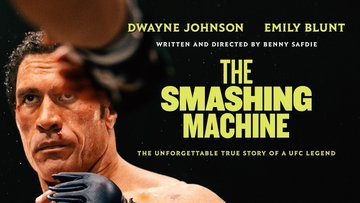
The Smashing Machine: If you’ve followed Dwayne “The Rock” Johnson’s career, you know him as the unstoppable action hero — muscles, bravado, blockbuster appeal. But in The Smashing Machine (2025), he takes a dramatic turn. He steps away from the spotlight’s glare and dives deep, portraying real-life MMA legend Mark Kerr. It’s a risky move, but one filled with grit, vulnerability, and emotional stakes.

A Glimpse into the Story:
The Smashing Machine is a biographical sports drama directed, written, and co-edited by Benny Safdie. The film draws inspiration from the 2002 documentary The Smashing Machine: The Life and Times of Extreme Fighter Mark Kerr. It tracks Kerr’s journey — his rise in MMA, the battles in the ring, and the demons he wrestled with outside it: addiction, personal relationships, and the burden of expectation.
Emily Blunt joins as Kerr’s partner, Dawn Staples, bringing emotional complexity to the narrative. Supporting roles include figures from the MMA world like Ryan Bader, Bas Rutten, and Oleksandr Usyk.
This is not your typical sports biopic. It’s raw, introspective, and willing to linger in painful spaces. The fight sequences are visceral, but the heart of the film lies in the struggles behind the mask.
Dwayne Johnson: Reinventing Himself
Johnson himself admits that this project was a turning point. He stepped into uncharted territory — away from spectacle, toward emotional risk. He spent long hours in prosthetics and makeup (sometimes three hours daily) to transform into Kerr. Even Emily Blunt admitted she hardly recognized him when she first saw the full transformation.
Johnson has spoken candidly about feeling “pigeonholed” by Hollywood as an action star and how The Smashing Machine was an opportunity to break that mold. He wanted to “rip himself open” — to go deeper emotionally than he ever had before.
One revealing moment: during filming, he tapped into childhood trauma — specifically memories of being evicted and insecure — to channel emotional weight for his character. That kind of authenticity is rare in big-name stars.
Johnson described this as not just a new chapter, but a new book in his career. And critics seem to agree — many see this as among his bravest, most vulnerable performances yet.
The Craft: Style, Tone, and Execution
One of the striking things about The Smashing Machine is its visual and narrative restraint. Safdie favored shooting on 16mm film, even using some 70mm and VHS cameras in parts, to give it a worn, lived-in texture. The cinematography doesn’t glamorize — it observes. It lets the grit show.
The pacing is deliberate — it doesn’t rush us through Kerr’s life but dwells in moments: his defeats, his anguish, his attempts to rebuild. That can be demanding for some viewers. But it’s the kind of film that asks you to lean in.
Critics have been mostly positive. On Rotten Tomatoes, The Smashing Machine holds a 72% critics’ approval rating, with praise especially for Johnson’s performance as a standout. Still, some note that the narrative occasionally feels underdeveloped or repetitive, especially in its domestic conflicts.
At Venice, the film premiered to a 15-minute standing ovation. It also earned Safdie the Silver Lion award for Best Director. It’s a movie that seems to resonate emotionally, even if its commercial prospects are uncertain.
Challenges & Risks:
Departing from the usual blockbuster fare is never easy. Some of the risks:
-
Box office vs. critical acclaim: The film’s emotional depth and slow burn may not appeal to audiences expecting fast-paced action.
-
Balancing realism and narrative drive: When a film focuses on internal struggle, there’s always a danger it can feel static.
-
Expectations: Johnson carries heavy expectations. If audiences come wanting the “Rock” they know, this deeper, darker version might surprise them — in good or bad ways.
-
Character empathy: Kerr is not a saint. To make the audience care, the script had to balance flaws with vulnerability. Some critics felt certain relationships — particularly the dynamics with Blunt’s character — were overdrawn.
Yet, one of the strengths is precisely that risk — that the film isn’t safe. It demands something from both actor and audience.
Why This Film Matters:
For Johnson, The Smashing Machine is more than just another credit. It’s a personal statement — a desire to evolve, to be seen differently, to tell stories that matter internally. It reflects an artist less interested in spectacle and more in depth.
For fans, it’s fascinating to watch “The Rock” disappear into another person. And for anyone who’s wrestled with struggle, ambition, or failure, it offers a mirror — imperfect, bruised, but honest.
It also reminds us: behind every fighter, literal or figurative, is a human being with scars we often can’t see.
The Smashing Machine isn’t perfect. It sometimes wavers in momentum. Some narrative threads feel underexplored. Yet, its core — Johnson’s transformation, Kerr’s haunted legacy, the emotional stakes — holds firm. This is a film made by someone reaching for something more, and it often lands.
Whether or not it becomes a box-office hit or Oscar favorite, for Dwayne Johnson, this seems like a victory already. He has discarded the comfort zone, embraced vulnerability, and given us a performance that reminds us: even the strongest personas can be haunted — and it’s the cracks that let the light in.
If you get a chance, see it in theaters. Let the fights hit; let the silences linger. And watch closely — because sometimes a movie is as much about what you feel between the punches as the blows themselves.
ऐसे और भी National लेखों के लिए हमारे साथ जुड़े रहें! Khabari bandhu पर पढ़ें देश-दुनिया की ताज़ा ख़बरें — बिज़नेस, एजुकेशन, मनोरंजन, धर्म, क्रिकेट, राशिफल और भी बहुत कुछ।
Shraddha Srinath की The Game You Never Play Alone – डिजिटल खतरे और महिला सशक्तिकरण की दमदार कहानी
1 thought on “The Smashing Machine: Dwayne Johnson’s Boldest and Most Emotional Transformation Yet”