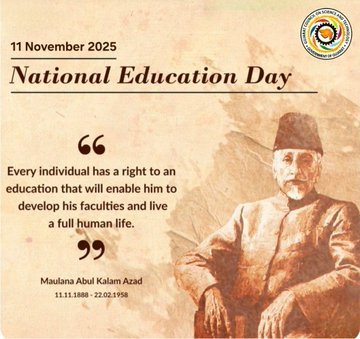
National Education Day 2025: Every year on November 11, India celebrates National Education Day, a tribute to Maulana Abul Kalam Azad, the first Education Minister of independent India. This day reminds us that education is not just a right- it’s the foundation of freedom, progress, and self-reliance. As the world rapidly changes with technology and innovation, the importance of education continues to evolve, shaping the destiny of individuals and nations alike.
The Visionary Behind the Day: Maulana Abul Kalam Azad
Maulana Abul Kalam Azad (1888–1958) was more than just a freedom fighter. He was a visionary who understood that India’s independence would be incomplete without intellectual liberation. Appointed as the first Education Minister after India gained independence in 1947, Azad worked tirelessly to build the educational framework of a new nation.
Azad’s belief in universal education was revolutionary for his time. He advocated free and compulsory education for all children up to the age of 14, regardless of caste, gender, or religion. He also emphasized women’s education, technical learning, and scientific research as key pillars for India’s future.
Under his leadership, several significant institutions were established, including:
-
University Grants Commission (UGC)
-
Indian Institutes of Technology (IITs)
-
Indian Institute of Science (IISc) expansion
-
Central Institute of Education (now NCERT)
Maulana Azad once said, “Education imparted by heart can bring revolution in the society.”
This statement reflects the essence of his philosophy- education is not just about literacy, but about nurturing thoughtful, responsible, and creative citizens.
Why National Education Day Matters:
Education is the backbone of any society. National Education Day is not merely a commemoration; it’s a call to action. It urges every Indian to value learning and contribute to building an inclusive education system.
The day highlights:
-
The importance of education in national development
-
Equal opportunities for all learners
-
Innovation in teaching and learning
-
The need to reduce educational inequalities
In today’s era of artificial intelligence, automation, and global connectivity, the purpose of education extends far beyond classrooms. It’s about empowering young minds to think critically, act responsibly, and dream fearlessly.
India’s Journey in Education: Then and Now
When India became independent, the literacy rate was below 20%. Many people, especially in rural areas, had little or no access to schools. Thanks to decades of consistent efforts- government policies, social movements, and community participation- India’s literacy rate now exceeds 77%.
Today, the education system is vast and diverse, comprising over:
-
1.5 million schools
-
1,000+ universities
-
40,000+ colleges
Government schemes such as Sarva Shiksha Abhiyan, Mid-Day Meal Program, National Education Policy (NEP) 2020, and Digital India have played pivotal roles in improving accessibility and quality.
However, challenges remain- dropout rates, digital divide, teacher shortages, and the gap between education and employability. National Education Day is a time to reflect on these gaps and find ways to bridge them through collective effort.
Education as a Global Equalizer:
Education is the world’s most powerful equalizer. It breaks the cycle of poverty, reduces gender inequality, and opens doors to innovation. According to UNESCO, every additional year of schooling increases an individual’s income by around 10%, and countries gain economic stability as a result.
In a globalized world, education also fosters cultural understanding and peaceful coexistence. When students learn about diverse traditions and viewpoints, they develop empathy and global citizenship- a need more urgent than ever in our divided times.
The Changing Face of Education in the Digital Age:
The last few years have completely transformed how we view education. Online learning platforms, virtual classrooms, and AI-driven tools have made education more flexible and accessible than ever. The pandemic accelerated this digital revolution, showing that learning can happen anywhere—beyond the walls of schools and universities.
But this transformation also revealed the digital divide- millions of children in rural India lacked internet access or devices. Bridging this gap is one of the most critical missions for policymakers and educators today.
As we celebrate National Education Day, it’s important to ensure that technology serves as a bridge, not a barrier. Digital literacy must become a fundamental part of modern education, enabling students to use technology creatively and responsibly.
Celebrating the power of education that transforms lives and builds brighter futures! On National Education Day, we honour the progress of Northeast India — where stronger infrastructure, better connectivity, and new opportunities are shaping young minds.#MDoNERIndia… pic.twitter.com/M7BL7dnlEs
— MDoNER India (@MDoNER_India) November 11, 2025
Education for Sustainable Development:
Modern education must not only teach skills but also values- especially sustainability, empathy, and responsibility toward the planet. Climate change, social justice, and equality are pressing global challenges, and education is the key to solving them.
The concept of Education for Sustainable Development (ESD) promotes environmental awareness and equips learners to make choices that ensure a better future for all. Schools and colleges today are encouraged to integrate sustainability into their curricula, helping students connect science with action.
How We Can Contribute:
National Education Day is not limited to schools or colleges; it’s for everyone. Every citizen can play a role in spreading education and awareness. Here’s how:
-
Volunteer to teach underprivileged children.
-
Donate books, stationery, or devices to those in need.
-
Support literacy programs in your community.
-
Encourage girls’ education and vocational training.
-
Promote lifelong learning- it’s never too late to learn something new.
When each of us becomes a torchbearer of education, we honor Maulana Azad’s vision in the truest sense.
Azad’s Legacy Lives On:
Maulana Azad’s legacy is not just in institutions or policies but in the millions of minds he inspired. His work laid the foundation for India’s educational journey, guiding us toward a future where knowledge is the ultimate power.
He believed that true freedom could only be achieved when people are educated, aware, and empowered to make decisions for themselves and society. His vision continues to shape India’s educational landscape, from the village school to the digital classroom.
Lighting the Path Forward:
National Education Day is not just a celebration- it’s a reminder of our collective responsibility. In honoring Maulana Azad, we honor the idea that every child deserves the light of knowledge. Education is not a privilege for a few; it’s a promise for all.
As we move ahead in this fast-changing world, let us ensure that our education system is inclusive, innovative, and inspiring. Let us nurture a generation that doesn’t just chase success, but also seeks wisdom, compassion, and truth.
Because in the words of Maulana Abul Kalam Azad himself:
“Education is the most powerful weapon which you can use to change the world.”

ऐसे और भी National लेखों के लिए हमारे साथ जुड़े रहें! Khabari bandhu पर पढ़ें देश-दुनिया की ताज़ा ख़बरें — बिज़नेस, एजुकेशन, मनोरंजन, धर्म, क्रिकेट, राशिफल और भी बहुत कुछ।
1 thought on “National Education Day 2025: Celebrating the Power of Learning and the Legacy of Maulana Abul Kalam Azad”