

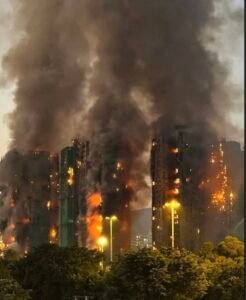
Hong Kong High Rise Inferno 2025: On 26 November 2025, a devastating fire ripped through a residential housing estate in Tai Po, Hong Kong – marking one of the deadliest fires in the city’s recent history. The blaze at Wang Fuk Court leapt across multiple high-rise towers, leaving at least 44 people dead, dozens injured, and hundreds missing or unaccounted for. As rescue efforts continue, what unfolded stands as a harsh reminder of the catastrophic potential of neglect, poor safety practices, and dense urban living.
What Happened: From Scaffolding Fire to Massive Inferno
-
The fire erupted around 2:51 pm local time on exterior scaffolding at Wang Fuk Court, a large apartment estate built in the 1980s.
-
The scaffolding structures, made from bamboo and wrapped in green construction netting for ongoing renovation, caught fire. Both bamboo and the netting are highly flammable, causing the flames to spread rapidly up the building exteriors and then into neighbouring towers.
-
Strong winds, the closely packed high-rise layout, and the use of additional flammable materials (e.g., foam-sealed windows, plastic mesh coverings) helped the fire spread to multiple towers in minutes.
-
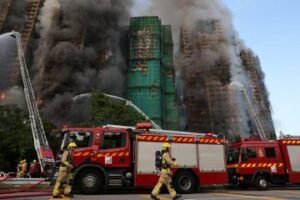
The fire quickly escalated, becoming a “five-alarm fire” — the highest emergency level under Hong Kong’s classification system. Firefighters fought the blaze for hours into the night as residents were evacuated, and many remained trapped.
The Human Toll: Loss, Chaos, and Uncertainty
The human cost of the tragedy has been staggering:
-
At least 44 people confirmed dead – among them a 37-year-old firefighter who died during rescue efforts.
-
More than 60 people were injured, with many in critical condition.
-
279 people reported missing or unaccounted for, sparking fears that the final death toll could climb.
-
Nearly 900 residents were displaced, many of them now living in temporary shelters.
-
Extensive property damage: entire towers collapsed into flames, with large swaths of apartments destroyed. Residents have lost homes and all their belongings.
The scale of destruction and the number of people affected have left families devastated – many are still awaiting news about missing loved ones. Rescue operations have been complicated by dangerous conditions: high temperatures, toxic smoke, falling debris, and unstable structures. Fire authorities said entering some buildings remains too risky even after the fire was “under control.”
What Went Wrong – and Why the Fire Spread So Fast:
Several factors contributed to turning a fire on scaffolding into a full-blown disaster:
-
Flammable renovation materials: Bamboo scaffolding is traditional in Hong Kong, but combined with green netting, foam-sealed windows, and plastic coverings – many of which were not fire-resistant – the risk was enormous. Investigators found that these materials likely accelerated the fire’s spread.
-
Dense high-rise layout: The estate comprises eight 31–32 storey towers, tightly packed – allowing fire and embers to jump easily between buildings.
-
Negligence & possible regulatory failure: Police arrested three men – two directors and one engineering consultant of the construction company responsible – on suspicion of manslaughter for gross negligence, citing unsafe practices during renovation.
-
Rescue difficulties: The fire department faced huge challenges – extreme heat, blocked stairwells, falling scaffolding, and smoke – all of which made immediate rescue almost impossible. Many residents were trapped in flats; some may have been overcome by smoke before evacuation was possible.
Legacy and Response: Mourning, Outrage, and Reflection
This fire – possibly the deadliest in Hong Kong’s peacetime history – has provoked shock, mourning, and anger across the city and beyond.
-
The detention of construction-company officials on manslaughter charges has reignited debate over building-safety regulations, especially around scaffolding and renovation standards. Many Hong Kongers demand stricter enforcement and accountability.
-
Questions are being asked: Why were obviously flammable materials used in renovations? Were safety norms ignored or corners cut to save costs? Could lives have been saved with better inspection and compliance?
-
The tragedy reawakens painful memories of earlier disasters – for example 1996 Garley Building fire, which killed 41 people, had long been considered Hong Kong’s worst high-rise fire before this incident.
-
For many residents, the fire underscores how vulnerable high-density, high-rise living can be – especially when combined with lax construction practices. Public trust in housing safety and governance may take a heavy hit.
-
As investigations proceed, community and international pressure mount for reforms: safer construction materials, mandatory fire-resistant upgrades during renovation, routine inspections, and transparent enforcement.
Remembering the Victims – and Lessons for the Future
At its heart, this tragedy is a human one. The numbers – 44 dead, almost 300 missing – only begin to tell the story of destroyed homes, uprooted families, lost dreams. Many of the estate’s residents were ordinary citizens – elderly folks, working-class families, children – simply living their lives. The death of a firefighter, too, adds a stark reminder of the dangers borne by first responders.
It is heartbreaking to see Hong Kong experiencing a major housing estate fire affecting more than 4,600 residents. It has become global news, and even after 13 hours, it is still not under control. Sadly, 36 people have lost their lives, including a firefighter.
Please keep them… pic.twitter.com/nY4SmkzJ67— Ying Tan (@YingTanForNY) November 26, 2025
Going forward, Hong Kong – and cities worldwide – must learn from this disaster. It underscores that:
-
Rapid urbanization and high-rise living demand strict adherence to fire safety standards.
-
Renovation practices must be transparent, with fire-safe materials – especially in densely packed residential zones.
-
Regulatory oversight must be robust: construction companies must be held accountable, and inspections must be regular and uncompromising.
-
Communities need better emergency preparedness – fire alarms, evacuation plans, fire-resistant cladding, and accessible escape routes.
Because in an environment of steel and concrete that reach high into the sky, safety measures are not optional – they are the lifeline.
The fire at Wang Fuk Court is more than a headline. It’s a warning. A heartbreaking one. As Hong Kong mourns its dead and searches for the missing, the world must watch – and heed the lessons.

ऐसे और भी Global लेखों के लिए हमारे साथ जुड़े रहें! Khabari bandhu पर पढ़ें देश-दुनिया की ताज़ा ख़बरें — बिज़नेस, एजुकेशन, मनोरंजन, धर्म, क्रिकेट, राशिफल और भी बहुत कुछ।
Exploring AI’s creative potential is fascinating-tools like 지브리 AI show how tech can honor artistic legacies while enabling new forms of expression. The blend of GPT-4o and diffusion models opens exciting possibilities for fans and creators alike.