
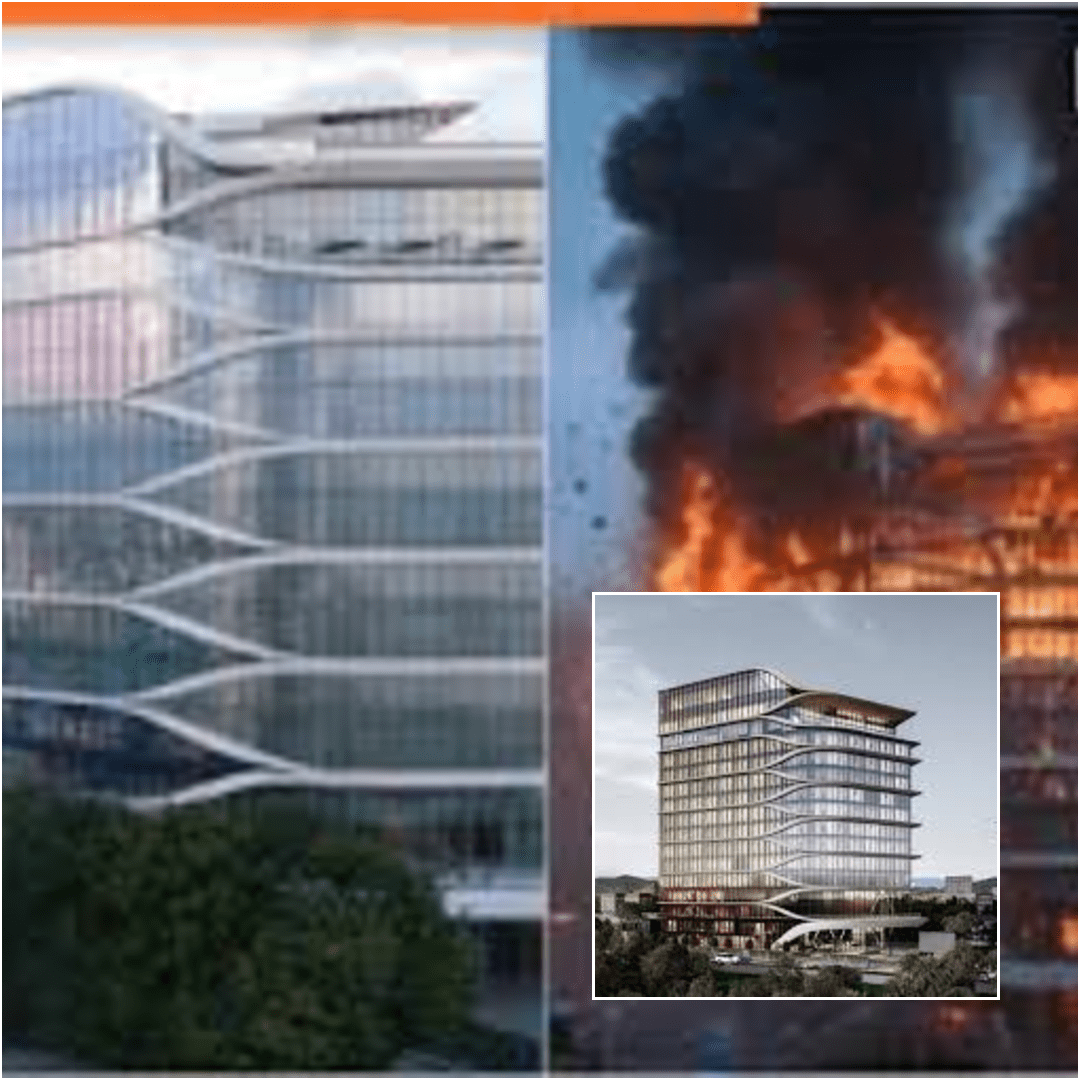
Hilton Hotel Kathmandu in Flames: The Hilton Hotel Kathmandu, once a shining symbol of Nepal’s modern hospitality industry, is now the center of global attention for tragic reasons. On this fateful day, amid escalating protests and political unrest, the luxury property was set ablaze by demonstrators, leaving its glass façade charred and its interiors reduced to rubble. The burning of the Hilton is not only a loss for Nepal’s hospitality sector but also a powerful symbol of the turbulence that has engulfed the nation.
From Luxury Landmark to Political Target:
Opened with great fanfare in 2024, Hilton Kathmandu was more than just a hotel. It represented Nepal’s entry into the global league of luxury destinations. Its contemporary design, inspired by prayer flags and Himalayan culture, attracted visitors from all over the world. Business leaders, diplomats, and tourists alike saw the Hilton as a place where modern amenities met cultural elegance.
Yet, today, the same landmark became a target of anger and frustration. Protesters, largely young demonstrators from Nepal’s so-called “Gen Z” movement, torched the building. Their actions were not random. The Hilton, standing tall in the heart of Kathmandu, was viewed by many as a symbol of political power and elite privilege. Reports suggested that its ownership ties to political families further fueled the mob’s rage.
The Wider Unrest:
To understand why the Hilton was attacked, one must look at the broader backdrop of Nepal’s turmoil. Over the past weeks, anti-government protests have intensified. Sparked by deep dissatisfaction with corruption, lack of opportunities, and unpopular restrictions, the movement quickly grew into a nationwide wave of anger.
The streets of Kathmandu became battlegrounds. Protesters clashed with police, blocked roads, and set fire to vehicles. Key institutions such as the Parliament, the Supreme Court, and even the Prime Minister’s residence were targeted. Against this backdrop, the Hilton Hotel—visible, symbolic, and associated with wealth—became a lightning rod for protester fury.
Scenes of Destruction:
Videos and eyewitness accounts paint a grim picture. Flames shot through the upper floors of the multistorey hotel, black smoke billowing into the sky. The once-glittering glass structure turned into a charred skeleton. Furniture, artwork, and interiors worth millions were destroyed in hours.
The fire service and security forces struggled to bring the situation under control. Guests and staff had reportedly been evacuated earlier, so there were no immediate reports of casualties, but the property itself suffered catastrophic damage. The Hilton, which had once been advertised as a “luxurious gateway to the Himalayas,” now stands as a haunting reminder of the volatility sweeping Nepal.
Tourism in Crisis:
The destruction of Hilton Kathmandu is a heavy blow to Nepal’s tourism industry. Tourism is one of the nation’s most important economic sectors, drawing visitors for its mountains, heritage sites, and cultural festivals. In recent years, efforts were made to attract high-end travelers by developing world-class hotels. Hilton was at the forefront of this push, alongside other international chains.
Now, the loss of Hilton is not just financial—it shakes confidence. Investors who saw Nepal as a growing hub for luxury tourism may hesitate. Travelers, too, are rethinking their plans. Already, international flights had been suspended temporarily due to unrest, though the airport has reopened with restrictions. The images of a five-star hotel burning are likely to linger, discouraging visitors who seek safety and stability.
A Blow to National Pride:
For many Nepalis, Hilton Kathmandu was more than a hotel. It was a point of pride, showing that their country could host dignitaries and celebrities with the same sophistication as any global city. Its destruction, therefore, is deeply symbolic. It reflects not only the anger of the protesters but also the fragility of progress in a nation where political instability often overshadows development.
The hotel’s charred remains now serve as a painful metaphor: a nation struggling to balance dreams of prosperity with the harsh realities of unrest and governance failures.
What Happens Next?
Rebuilding Hilton Kathmandu will be a massive challenge. The financial cost alone runs into millions of dollars, not to mention the time needed to restore confidence among tourists and investors. Questions will also arise about insurance coverage, ownership responsibilities, and Hilton’s global response.
At a deeper level, the government faces the urgent task of restoring order and addressing the grievances of the youth. Unless political leaders find ways to engage with the demands of the protesters, today’s tragedy may repeat itself elsewhere. Stability, once restored, will be key to encouraging reconstruction and reviving the hospitality sector.
A Turning Point for Nepal:
Today’s events mark a turning point in Nepal’s modern history. The burning of Hilton Kathmandu is not an isolated incident—it is part of a broader rejection of corruption and inequality. It shows that symbols of privilege, no matter how grand, can quickly become targets in times of anger.
For Nepal, the challenge now is to channel this unrest into constructive reform rather than destructive violence. The Hilton can be rebuilt, but the deeper wounds of mistrust and frustration require careful healing. Only then can the nation hope to reclaim its image as a land of peace, culture, and hospitality.
The sight of the Hilton Hotel Kathmandu in flames is one of the most shocking moments in Nepal’s recent memory. A place that once welcomed guests with luxury and grace now lies in ruins, consumed by the anger of a generation demanding change.
This tragedy is more than the loss of a building—it is a warning. It shows how fragile development can be in the absence of political stability, and how quickly years of progress can vanish in smoke. As Nepal looks ahead, the hope is that out of this destruction comes renewal, not just of hotels and infrastructure, but of trust, governance, and unity.
For now, the Hilton stands as a blackened shell—a reminder that behind every flame lies a deeper story waiting to be addressed.
ऐसे और भी Global लेखों के लिए हमारे साथ जुड़े रहें! Khabari bandhu पर पढ़ें देश-दुनिया की ताज़ा ख़बरें — बिज़नेस, एजुकेशन, मनोरंजन, धर्म, क्रिकेट, राशिफल और भी बहुत कुछ।
Wife of Former Nepal PM Jhala Nath Khanal Rajyalaxmi Chitrakar Dies in Protest Violence