
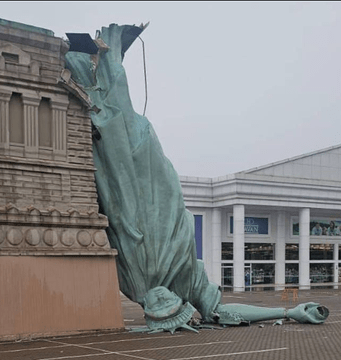
Statue of Liberty Brazil: In mid-December 2025, dramatic videos and social-media posts of a Statue of Liberty replica collapsing in Brazil went viral worldwide – sparking curiosity, surprise, and confusion. But this wasn’t the famous Statue of Liberty in New York. Instead, a giant replica in southern Brazil’s city of Guaíba was toppled by powerful winds during a severe storm, grabbing global attention and making headlines across major news outlets.
Here’s the full story – and why this incident became such a talking point.
1. The Incident That Sparked Global Interest
On December 15, 2025, a 24-metre-tall replica of the Statue of Liberty outside a Havan megastore in Guaíba, Rio Grande do Sul collapsed during a powerful storm. Footage widely shared on social media shows the tall statue tilting under intense gusts of wind – reported to be between 80 and 90 km/h – before crashing to the ground.
Thankfully, nobody was hurt. Local authorities and representatives from Havan, the retail chain that owns the replica, confirmed that the area was relatively empty at the time, and employees moved vehicles and secured the site quickly after the collapse.
The dramatic visuals – a towering statue leaning, bending, and then falling under nature’s force – struck a chord on the internet, making the story go viral and prompting international news coverage.
As a New Yorker, this was WILD TO WATCH.
No, this is not the Statue of Liberty in New York. it is the one in Guaíba, Brazil. It was knocked over by 90 km/h winds! pic.twitter.com/H0u5oGdFb5
— Ryan Rozbiani (@RyanRozbiani) December 15, 2025
2. So Why Is There a Statue of Liberty in Brazil?
To understand why this wasn’t just another local story, it helps to know why replicas of the Statue of Liberty exist in Brazil in the first place.
The original Statue of Liberty – a gift from France to the United States – stands in New York Harbor and has long symbolized freedom, hope, and opportunity. It’s one of the world’s most recognized monuments.
But beyond New York, replicas and reinterpretations of this iconic symbol have been erected in many countries worldwide — and Brazil is one of the nations with the most duplications of Lady Liberty.
In Brazil, many of these replicas have been installed by Havan, a large retail chain founded by businessman Luciano Hang. Havan is known for placing giant versions of the Statue of Liberty outside its stores as part of its branding and corporate identity. These statues have become a recognizable (and sometimes quirky) part of the Brazilian landscape.
According to multiple community accounts and travel enthusiasts, Brazil may have more Statues of Liberty than any other country, with over a hundred such replicas spread across cities and towns, from major metropolitan areas to smaller communities.
For many Brazilians, these replicas are simply familiar landmarks – part of the visual identity of various Havan stores. But for those outside Brazil, seeing such a familiar global icon in a very different context feels unusual and newsworthy.
3. Why Now? The Storm and Viral Spread
So why did this particular replica fall into the news spotlight?
The answer is a mix of natural forces, timing, and social media amplification:
-
Extreme Weather: Southern Brazil recently experienced a powerful storm system. The high winds were strong enough to compromise the structural stability of the statue, ultimately leading to its collapse.
-
No Casualties but Dramatic Footage: Luckily, no one was injured, which made the story safe to share without tragic undertones. But the slow motion and dramatic tilt of this towering statue made for compelling visuals that spread widely online.
-
Social Media Virality: Viral videos often transform local events into global topics. In this case, people around the world reacted with surprise, disbelief, and even humor as clips of the collapse circulated on TikTok, Instagram, Twitter, and Facebook.
For many outside Brazil, the idea of a Statue of Liberty falling over in South America sounded almost surreal – creating a mix of humorous memes and curious news consumption.
4. Reaction and Commentary:
Essentially, the reactions have fallen into a few broad categories:
A. Brazilian Local Response
Local authorities in Guaíba and Havan officials focused on public safety, confirming that everyone was safe and that investigations would follow to determine why the structure failed under strong winds.
City leaders praised the quick action of staff and emergency services. Residents expressed mixed feelings – some concerned about the storm’s impact, others viewing the collapse of a symbolic statue with amusement or relief that it didn’t cause harm.
B. Global Reaction
Outside Brazil, many commentators were confused at first – some tweeted as if the real Statue of Liberty had toppled. Once it was clarified that the statue was a replica, many users reacted with humor or curiosity about why Brazil has these replicas in the first place.
The incident also sparked discussions about weather patterns and infrastructure safety, since structures of this size need to withstand extreme conditions, particularly in regions prone to strong gusts.
5. Broader Context: Public Monuments and Symbolism
Beyond the immediate incident, the story touches on how monuments and replicas shape cultural narratives.
Symbols like the Statue of Liberty, originally designed to celebrate freedom and welcome immigrants, have taken on different meanings in global contexts. While in the U.S. this statue is deeply tied to immigration history and national identity, in Brazil it has become a brand identifier and a quirky architectural feature of corporate spaces.
Whether one views these replicas as meaningful cultural icons or as kitschy marketing tools, events like this remind us how potent public symbols can be – and how quickly they can capture global imagination when something unexpected happens.
More than Just a Fallen Statue:
What made the story of the “Statue of Liberty Brazil” worth international coverage wasn’t simply a statue falling — it was the intersection of global symbolism, local identity, dramatic weather, and social-media storytelling.
A structure that visually echoes one of the world’s most famous monuments suddenly collapsing in a storm outside a shopping megastore, provided a moment both dramatic and reflective. It showcased how modern digital networks can turn local happenings into global conversations, and how cultural symbols travel, evolve, and sometimes crumble — literally and figuratively — in new contexts.
In the end, this incident became more than just a weather story. It became a reminder of why certain shapes, figures, and icons resonate across continents – and how quickly a local moment can become part of the world’s attention.
ऐसे और भी Global लेखों के लिए हमारे साथ जुड़े रहें! Khabari bandhu पर पढ़ें देश-दुनिया की ताज़ा ख़बरें — बिज़नेस, एजुकेशन, मनोरंजन, धर्म, क्रिकेट, राशिफल और भी बहुत कुछ।
Bondi Beach Tragedy: A Terrorist Mass Shooting at Hanukkah Celebration