
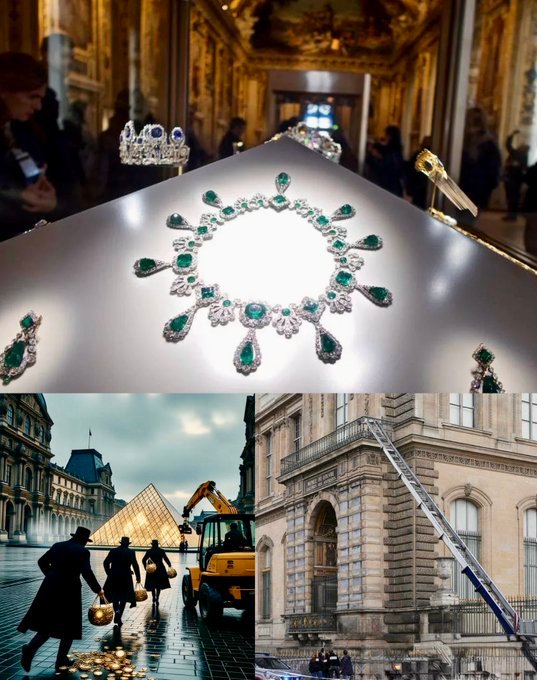
The Daring Louvre Museum Robbery: On the quiet morning of October 19, 2025, the world woke up to shocking news from Paris — a robbery at the iconic Louvre Museum, home to the Mona Lisa and centuries of priceless art. In what French officials have called an “extraordinarily swift and professional” operation, thieves broke into the Galerie d’Apollon, the section housing the French Crown Jewels, and vanished with some of the most valuable artifacts in French history.
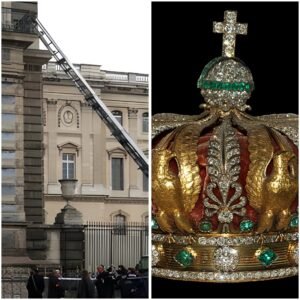
The entire heist lasted barely four minutes – yet its impact will echo for decades.
The Morning of the Heist: The Daring Louvre Museum Robbery
A Calm Beginning Turns Chaotic:
At around 9:30 a.m., moments after the museum opened to the public, two masked individuals approached the Louvre from the Seine River side, where construction scaffolding had been set up for restoration work. Using a mechanical lift (cherry picker), they reached a second-floor balcony and shattered a window with a disc cutter, gaining direct access to the Galerie d’Apollon.
Visitors in nearby rooms reported hearing a brief metallic sound but thought it was part of the ongoing maintenance work. Within seconds, the thieves smashed open two glass display cases holding royal jewels – and were gone before guards could react.
A Four-Minute Operation:
Speed, Precision, and Planning:
According to CCTV footage and witness reports, the robbers had timed everything perfectly. Two scooters waited below the balcony, engines running. Inside, the thieves grabbed eight historic jewelry pieces before fleeing through the same route.
French Culture Minister Rachida Dati later confirmed:
“The break-in, from entry to escape, took just about four minutes — an astonishing display of precision and planning.”
Police believe the group had scouted the site for weeks, exploiting the temporary security gap caused by ongoing renovations.
The Stolen Treasures:
Jewels of Empire and Royal Legacy:
The Galerie d’Apollon is one of the Louvre’s most breathtaking halls, adorned with golden ceilings and royal emblems. It houses the French Crown Jewels, once worn by emperors, queens, and empresses of the Napoleonic era.
Among the stolen treasures were:
-
An emerald and diamond necklace gifted by Napoleon I to Empress Marie-Louise.
-
A sapphire necklace and earrings once owned by Queen Marie-Amélie.
-
The crown of Empress Eugénie, wife of Napoleon III, was later found outside the museum, damaged but recovered.
Fortunately, one of the most precious items — the Regent Diamond, one of the world’s finest gemstones — remained untouched.
Authorities described the total loss as “inestimable,” not because of market value, but because of the historical and emotional heritage attached to each piece.
How the Thieves Escaped:
A Vanishing Act on the Streets of Paris:
The escape was just as swift as the robbery. As alarms triggered, the thieves leaped onto two black scooters waiting by the riverbank and sped off through the narrow streets of central Paris.
Police later found the damaged crown and several discarded tools — including the angle grinder and gloves — near the Pont du Carrousel bridge.
Surveillance cameras caught glimpses of the scooters merging into traffic, but their license plates had been removed or faked.
The entire route, from balcony to river exit, had clearly been mapped in advance. Investigators called it “a military-style operation.”
Immediate Aftermath:
The Louvre in Shock:
Within minutes, the museum went into lockdown. Visitors were evacuated, and all entries sealed off. The Louvre later stated on social media:
“The museum has closed temporarily for exceptional reasons. An investigation is underway in coordination with the Ministry of Culture and the Paris Police Prefecture.”
President Emmanuel Macron called the theft “an assault on France’s soul,” emphasizing that the stolen pieces represented “centuries of art and identity.”
Meanwhile, Paris police launched “Operation Apollon”, involving art-crime experts, forensics teams, and Interpol coordination.
They walked into Louvre Museum at 9:30 a.m.
Used a crane. Smashed a window.
Stole the French crown jewels in 4 minutes.
No violence. Just precision.If a world-famous museum can be robbed in broad daylight… what does that say about the guardians of culture? pic.twitter.com/cUn0DX9qnx
— Culture Explorer (@CultureExploreX) October 19, 2025
Security Questions Raised:
How Could This Happen at the Louvre?
The heist has reignited debate over museum security standards worldwide. Experts point to several critical lapses:
-
Construction Work Access: The ongoing façade renovation gave the thieves a rare opening to reach an otherwise secure balcony.
-
Understaffing: The Louvre had recently faced internal complaints about limited guards during early hours.
-
Open-Hour Vulnerability: Conducting the theft during opening hours avoided triggering the full night security protocols.
Art-security consultant Jean-Baptiste Roux commented:
“The robbers didn’t just steal jewels – they exploited the museum’s trust in daylight and its openness to the public.”
The Investigation and Hunt for the Thieves:
A Race Against Time:
French authorities believe the gang was highly professional and possibly international. Early leads suggest they used stolen scooters and false identity documents.
Interpol has been alerted, and border checkpoints in Belgium, Switzerland, and Italy have been notified.
Experts warn recovery will be difficult — stolen jewels can be re-cut or melted, erasing their identity forever. Some may end up in private black-market collections across Europe or the Middle East.
However, police remain optimistic, citing DNA evidence found on the abandoned equipment and video surveillance tracing the suspects’ escape path.
A Blow to French Cultural Heritage:
More Than a Robbery – A Symbolic Attack:
To many in France, this crime is not merely about lost jewels, but about theft of history itself. These pieces once adorned the royal family, representing eras of power, art, and craftsmanship.
The loss has deeply affected museum staff and historians, who describe it as “a tragedy for cultural memory.”
Tourism officials fear that public confidence may dip temporarily, prompting tighter security and reduced visitor freedom.
Yet paradoxically, such events often revive interest in the artifacts themselves — as the world watches, hoping for their return.
Lessons from History:
This is not the Louvre’s first brush with theft. Over a century ago, in 1911, the Mona Lisa was stolen by a former employee and recovered two years later.
However, the 2025 Louvre Robbery is far more audacious — executed in broad daylight, using modern tools, and targeting royal treasures rather than paintings.
It serves as a reminder that even the most secure institutions can be vulnerable when creativity and crime combine.
The Road Ahead:
The Louvre is now conducting a complete security review, planning to reinforce vulnerable entrances and upgrade alarm systems. Meanwhile, the French government has ordered all national museums to undergo similar safety audits.
Public appeals for information have been launched, with a €2 million reward reportedly offered for credible tips leading to recovery.
Cultural experts urge patience and hope — many famous art thefts have eventually been solved, sometimes years later.
A Wake-Up Call for the Art World:
The Louvre Museum robbery of 2025 will be remembered not only for its precision and daring but also for what it symbolizes — the thin line between preservation and vulnerability.
As investigators work tirelessly to track the missing jewels, one thing remains clear: the world’s heritage is only as safe as our vigilance allows it to be.
The golden Galerie d’Apollon may one day shine again with its full glory restored, but until then, it stands as a silent reminder — even the greatest treasures on Earth are never beyond reach.
ऐसे और भी Global लेखों के लिए हमारे साथ जुड़े रहें! Khabari bandhu पर पढ़ें देश-दुनिया की ताज़ा ख़बरें — बिज़नेस, एजुकेशन, मनोरंजन, धर्म, क्रिकेट, राशिफल और भी बहुत कुछ।
What the hack?
обслуживание бойлеров [url=http://www.remont-boyler-na-domu.ru]https://remont-boyler-na-domu.ru/[/url]